Showing posts with label quilt history. Show all posts

Wednesday, 31 January 2018

Old Quilts from the Guild and New Quilts by me

Two velvet log cabin blocks
I'm going to stop apologising for the time between posts.  Life is, happily, very busy and when it comes to down to do I write a blog post or get things ready for the students due in the next day - class prep wins every time.  
Detail of a sateen wholecloth
So when I can, I'll add a post of happenings.
A coverlet made from shirting samples
In November, to help the C&G Diploma students with their illustrated study of the history of British Quilting, I borrowed a suitcase collection of quilts from the Quilters' Guild.  Over the course of the two week loan period, each group got a chance to see the quilts and the stories about them got developed and embellished, as there is little factual information about their history.  
Detail of a silk hexagon coverlet
Why did the maker of this beautiful silk hexagon quilt stop?  Did she hate making it?  Was she forced by her mother and stopped the moment she left home?  Did her eyesight fail?  Did she fall into poverty and couldn't afford any more ribbons for it, but couldn't make herself cut it up to be used more practically?  Did she pass away and her daughters couldn't bear to continue?  Wondering about the makers is a lot of fun.  It is a shame we know so little, which is why quilt historians are adamant that every quilt should be labelled to help future historians with their musings.  I admit this isn't something I'm always good at.
Detail from another wholecloth, with a heavy wool wadding
To give others who aren't students here a chance to see these quilts, I had an Open Day.  Alongside the antique quilts, I displayed some of my newer pieces.  It was lovely to juxtapose the old and modern, seeing the similarities and the differences.  The cake also went down well, and was definitely kept in a separate room from all these antique quilts!
After everyone had left
Of course, being me, I forgot to take photos when the room was filled with visitors, but it was suitably busy and enjoyable.  The collection, called 'Textile Treasures' is still available to be borrowed from the Guild.  Despite the responsibility of having to look after the antique quilts, I really enjoyed having them here.

Monday, 12 September 2016

Textile Treasures from the Quilters' Guild

Detail of a 1930s quilt made with an astounding array of dress making fabrics
As part of the C&G Diploma in Patchwork and Quilting, you have to write an illustrated study of British Quilt History.  To help make this come alive, I've borrowed a suitcase collection of historical quilts, called Textile Treasures from the Quilters' Guild to share with my students.  It is amazing what will fit into one suitcase.  It was even more exciting when I was finally able to open it - the case was padlocked and I didn't have the combination to start with!
Visitors to the Open Day
As it was here, I thought it would nice to share with others who may be interested and so I had an Open Day last Friday.  I had no idea how many people, if any, would turn up, but in the end, even in the rotten weather, we had a lovely crowd of about 60 across the day.  The age range was 17-90 which was fantastic, most of us fascinated by textiles, with a few reluctant partners dragged along.
More visitors - isn't my studio really tidy for once!
I've now seen this collection three times and it is amazing the different insights each group has about the quilts.  It can be difficult when you first look at an old quilt to appreciate it and that is part of the beauty of having this collection here - understanding how to look at these historical textiles and learning what we can from them.
Here are some quick points we have learned:

  • some of the ugliest quilts have the most brilliant stories behind them, like this Canadian Red Cross Quilt, which was given to a family who had been bombed out three times in World War II
Canadian Red Cross Quilt
  • some of the hand-stitching is stunning, especially when it has been stitched by candle or gaslight.  And if you look closely enough, not all the shapes are as crisp as they should be.  So quilts were fudged years ago as well and we don't notice it on other people's quilts straight away, nor does it diminish our pleasure of them (there is a moral there!)
One inch hexagon quilt
  • some of these quilts have their small pieces made up from scraps or they have used mended fabric, so nothing was wasted.  I can't imagine piecing two bits of fabric to make a one inch hexagon.
  • on the other hand, some of these quilts were made from new, good fabric as you can still see the glaze on the chintz, which would have washed off if it had been laundered.  
A hexagon quilt, which has been carefully 'fussy-cut'
  • you can learn a lot about printing techniques and chemical development over time by looking at the different printed cottons used.  Green was hard to make, so blue was over-printed with yellow.  Where it didn't line up, you can see the blue and yellow still.
  • fabric doesn't last forever and decay depends on what chemicals were used to dye it.  
  • quilters have always loved the new and 'exciting'
Two North Country Quilts.  The one of the left must have been one of the earliest to use viscose rayon as the fabric
  • just because it is old does not mean it is very good - we shouldn't lose our ability to be discerning when faced with something that has been lovingly preserved over the years.  However, this is a judgement call and we all have different tastes, thank goodness.
Two more of my C&G groups still have to see the collection before I return it.  If you get the chance, I would highly recommend borrowing it and spending time with these historical objects.


Tuesday, 7 June 2016

Books about British Quilt History

After our day out last week for the Diploma Summer School, we spent three days in the studio, enjoying historical quilts and getting frustrated with mathematical sequences and progressions!  Lesley, a reader of this blog, asked about books on British Quilt History and as this is something we have just been doing, I have all the information to hand for a blog post.  This is not a definitive list of books on British Quilt History, just ones I have in my collection and which I have found useful.  


This is the book I refer to the most.  Well written and researched, with many images.  Something strange is happening with my images, so either you are seeing this book twice or not at all!  Apologies.  It is Janet Rae's The Quilts of the British Isles in case it is not showing up.
Traditional British Quilts: Dorothy Osler
Not a recent book, but for me, the one where all the interest in the history of British Quilting kind of started from.  Since it was written, much more research has been undertaken and more information has been discovered, but still a great starting point.

Patchwork and Quilting (Shire Library) by [Audin, Heather]
Part of the Shire Library series of short books, primarily on subjects you never imagined anyone would write about!  A good short introduction, written by the curator of the Quilters' Guild Collection

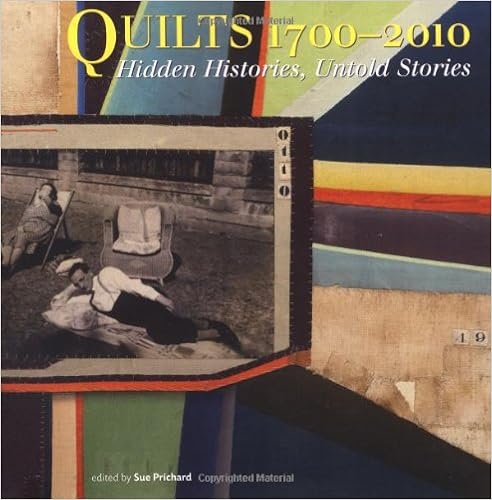
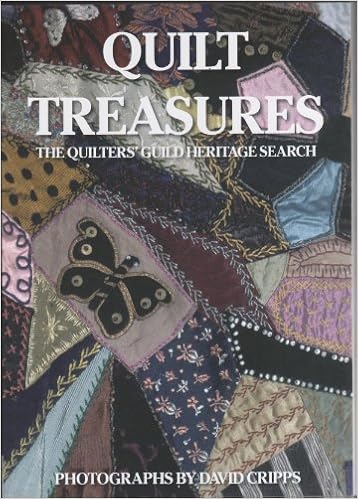
A great exhibition and a lovely catalogue, with large full colour photos and lots of essays written by different people, with different views and approaches.
Another good exhibition and related catalogue

The journal of the British Quilt Study Group of the Quilters' Guild, published annually contains papers presented at its conference on a wide variety of quilting matters past and present.

This book is titled, you just can't see it on the cover!  It is Making Connections by Janet Rae and Dinah Travis, all about the history of log cabin quilts


At the less scholarly end, the relatively new magazine Today's Quilter has had a couple of supplements about different aspects of  British quilt history over the past year, often abridged from books.

Most of these books are available on Amazon.  A word of warning: the prices on Amazon can be a little bit bizarre as some of these books are out of print and don't get offered on Amazon often.  You should be able to pick them up second hand for under £10 each.

A book that I don't have, but which I would like to own as it is very informative:


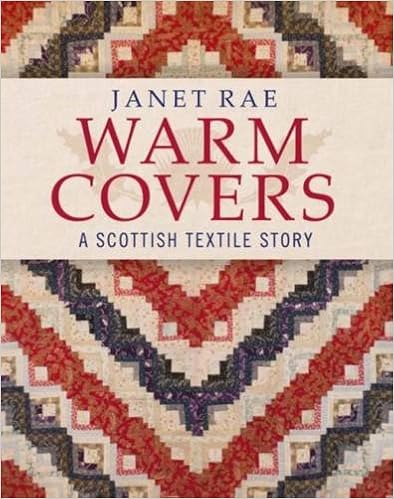
And finally, coming out later this month, so I haven't read it, but I do have it on order:

Jan has written a number of books on British quilting, and I know she has put a considerable amount of research into this, her latest title.  I can't wait to get my hands on it.

Which books have I missed or that you find informative?  Are there any gaps in the documentation of British quilting history that you think need to be addressed?

Monday, 16 November 2015

Inspiration: Eye on Elegance at the DAR Museum

Eye on Elegance Exhibition
Eye on Elegance was an exhibition of antique quilts at the DAR Museum in Washington DC, USA, this summer.  I wish I had been lucky enough to visit as was my friend, Louise Carr.  However, I got second best as she kindly gave me a copy of the catalogue.  As well as the catalogue and physical show, the DAR Museum has also mounted a big and informative online exhibition of these quilts, which is well worth a look.  You can access it here - http://eyeonelegance.dar.org/ .
Pieced and Stuffed Medallion Quilt about 1810 and 1820s
For anyone interested in historical quilts, it is a must.  For others though, there is lots of interesting titbits to be gleaned.  As well as the quilts, which are organised by type (AppliquĆ©, Pieced, Album, Migration and Wholecloth), there is historical information about the makers and the designs and fabrics used.  A few facts that caught my attention:
·         The quality of the stitching is stunning.  Some of these quilts have up to 12-13 stitches per inch.  Reading this made me flick through the catalogue to look at the different standards – even the ‘worst’ has 6-7 stitches per inch. I think I would struggle to draw 12-13 stitches per inch, let alone stitch them!
Reverse Applique Flower Basket Quilt 1849
·         These are not ‘make-do-and-mend’ quilts.  Some of the fabric cost more per metre than a farm hand would earn in a week.  I would be terrified to use such expensive fabric now in case I got it wrong.  Unsurprisingly, many quilters followed patterns and sometimes it seems you could buy a kit ready basted ready for you to stitch down the appliquĆ© and then quilt.  This would still be very time consuming.
·         The curator makes the point that even when there is one named quilter (and there is much information on their individual lives, which is fascinating), often any woman who could stitch to a high standard living in that household would be commandeered into helping – including servants and slaves.  I admit knowing this changed how I looked at some of the quilts.  We have this lovely cosy view of a sole maker inviting her friends to a quilting bee to finish off her masterpiece, but how much does this actually reflect reality?  Did these woman see stitching as a break from their normal routines, or resent being made to do it?

Although these quilts are over 150 years old, it is surprising how relevant they are to today.  
Tree of Life and Birds quilt 1810s
For example, I was teaching Broderie Perse to my City & Guilds Certificate Group yesterday – it is part of the syllabus.  No, none of them were using pieces of chintz that cost over £200 a metre, but it is the same process.  And the other month with the Diploma Group, we were looking at borders and their proportions, just like the medallion quilts in this exhibition, which were very popular at that time.  
Mathematical Star Quilt 1830s
And I love the star design, and was already thinking of making one using paper piecing, even before I saw this book.  Actually, I’m trying to dissuade myself due to lack of time and to concentrate on my 4-years-and-counting hexagon paper pieced quilt, which is still going to need another 3 years!

If you have the opportunity, I would thoroughly recommend reading the book - the photos are stunning and there are lots of detailed shots -  and having a flick through the online exhibition.  And fingers crossed that one day I can get to see some of these quilts in person.


All images used with kind permission from the DAR Museum.


Monday, 31 August 2015

Scottish quilt history introduction

Scottish Log Cabin

As part of the C&G Diploma in Patchwork and Quilting, the students need to learn about the last 200 years of their local quilt history, so for my class that is British quilts.  I wanted us to go and visit a collection of historic quilts, but there isn’t really one locally.  I think many of the museums have one or two, but that wasn’t enough to justify a visit.  However, there is nothing like actually seeing and touching the quilts to bring them to life.  Luckily someone suggested I got in touch with Hazel Mills and she in turn suggested that Jan Rae could help and both of them came out here on Saturday to share their quilts and knowledge with us. 
A Hawick broken heart quilting pattern
I’m sure it was of benefit to the students, but it was also magnificent for me.  Although I have a reasonable knowledge of quilt history, as I am interested in history in general, Hazel and Jan were amazing.  Their combined knowledge was huge and we learnt about many different styles and types of British quilts.  For example, I knew about North Country and Welsh quilting, but I hadn’t heard of Hawick quilting, with its distinctive broken heart pattern and often thistles too.  As we expected, there were many wholecloth examples, which of course, don’t photograph well and so seemed much more impressive in real life than just as illustrations in books.  Jan also explained about ‘Comfy’ quilts, an actual brand name of manufactured quilts, which were very popular for a while.  They are completely reversible.
The 'Comfy' Quilt

The C&G syllabus says the students should also be aware of regional variations.  So as well as the wholecloth quilt showing the broken hearts and thistle indicative of Hawick quilting, we saw some other distinctively Scottish ones, such as this lovely blue based log cabin and also an unusual (for Scotland) quilt with Turkey Red stars.  
Turkey Red Star Quilt

This was fascinating as one quilt history book I had read said that there was no quilting tradition in Scotland.  Obviously, this isn’t true – maybe it is just more hidden or less celebrated than in other countries or part of the UK.
Looking at the log cabin
Although we were concentrating on British quilts, we did get to see some other gems such as Hazel’s Kantha from India.  Jan also brought along some American quilts and it was interesting to see the differences.


Hazel's Kantha


An exciting part of the experience was being able to handle these quilts, all of which were in fantastic condition.  For example, it was amazing to feel the variations in wadding between a wool one and a cotton one.  Indeed there one was which we were still unsure at the end of the day whether it contained wadding or not, it was so fine.  Another had obviously been washed several times and the wadding had split and concentrated at the quilting.  It made it a lot easier to see the quilting patterns when you held it up to the light.  It was a really privilege to be able to handle all of these quilts.  I’m incredibly grateful to both Hazel and Jan for sharing all their knowledge so generously with us and bringing quilt history alive for us.   I also have to admit I did my ‘fan girl’ bit and got Jan to sign my copy of her book ‘The Quilts of the British Isles’ – the best book on the subject!

My favourite was one of the last ones we saw – made almost entirely from quarter square triangles, this quilt was a very patriotic one.  The red and white triangles divided the quilt, like the bands on the Union Jack flag and in the border, used in bigger chunks was a fabric celebrating the Golden Jubilee of Queen Victoria in 1887.
Queen Victoria Golden Jubilee fabric


Related Posts Plugin for WordPress, Blogger...

Popular Posts